Free Alphabet Tracing Worksheets — All 26 Letters (A–Z)
Free printable letter tracing worksheets for every letter A–Z. Each sheet gives children aged 3–6 guided practice with uppercase and lowercase letters — trace the model, then write from memory. No sign-up. No watermark. Just print and go.

Choose a letter
Why alphabet tracing works
Tracing letters by hand is one of the most effective ways young children learn the alphabet. When a child traces the shape of a letter repeatedly, their brain forms a strong link between the visual form, the motor movement, and the sound — a combination that reading purely on-screen rarely achieves. Studies in early childhood literacy consistently show that children who practise handwriting alongside phonics instruction develop stronger letter recognition and reading fluency.
Each Todpoles worksheet follows a proven sequence: a solid model letter to study, followed by faint tracing copies, ending with blank lines for free writing from memory. This trace-copy-recall pattern means children aren’t just copying shapes — they’re beginning to write independently.
What is on each worksheet
Uppercase letter
A solid model followed by four faint copies to trace. Children see the correct letterform then practise it immediately in the same row.
Lowercase letter
Same trace-and-repeat format for the lowercase form. Both cases on one sheet so children learn the pair together — as they appear in real reading.
Free-write lines
Open lines at the bottom for writing without a guide. This is the most important part — where tracing becomes real writing and memory takes over.
Frequently asked questions
Are all 26 letter worksheets free?
Yes — every letter A–Z is free to download individually, or you can get all 26 in one PDF bundle using the button at the top of this page. No sign-up, no watermark, no payment.
What age are alphabet tracing worksheets for?
These worksheets are designed for children aged 3–6. Children aged 3–4 typically work on one letter row per sitting. Children aged 5–6 can complete the full sheet — uppercase, lowercase, and the free-write section — in one session.
Can I print each worksheet more than once?
Yes, print as many copies as you like. We recommend using a pencil so children can erase and repeat the tracing rows until the letter feels comfortable. Most children need 3–5 sessions with a letter before writing it confidently from memory.
Which letter should I start with?
For most children, starting with the letters in their own name works best — personal connection accelerates retention. After that, common teaching sequences start with easier shapes (like L, T, I) before moving to more complex letters (like S, G, Q). If you’re following a phonics programme, align the worksheets with whichever letter sound your child is working on this week.
- Ages 3–4: Focus on one letter per session. Let the child trace the row slowly, saying the letter name aloud each time.
- Ages 5–6: Work through uppercase and lowercase in one sitting. Challenge them to write the letter from memory in the open lines.
- Tip: Pair the worksheet with the Todpoles flash card for that letter — children who connect the shape to a card and a word retain it faster.
Todpoles App
More learning with Todpoles
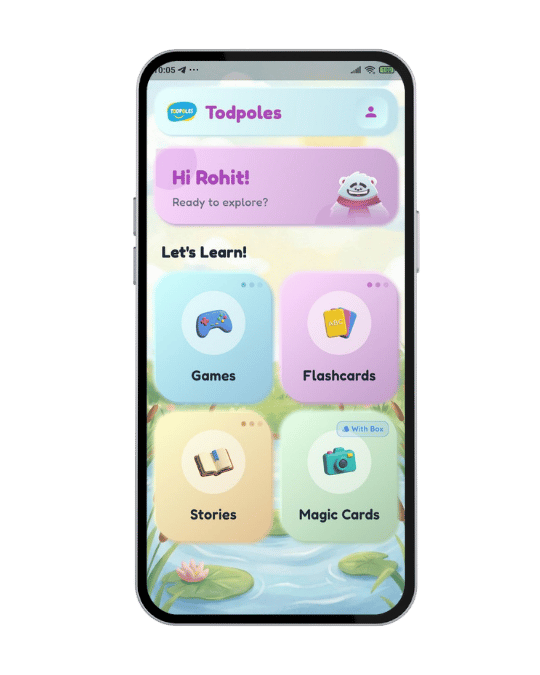
The Todpoles app turns these letters into interactive games. Scan any flash card, hear the letter sound, and play matching activities — all anchored to the physical learning your child is already doing with these worksheets.