
How to Teach Phonics to Toddlers at Home: A Practical Parent’s Guide

Phonics has a reputation for being complicated — worksheets, drills, blending exercises, and strict sequences that make the whole thing feel more like school than play. But for children aged 2–6, phonics at home doesn’t need to be any of that.
The research is clear: the most effective early phonics happens in short, playful bursts — embedded in games, songs, and daily routines. This guide gives you a practical framework for teaching letter sounds to young children at home, without pressure, without confusion, and without needing to be a teacher.
What phonics actually is (and what it isn’t)
Phonics is the understanding that letters represent sounds — and that those sounds can be blended together to form words. It is distinct from two other skills that often get confused with it:
- Letter recognition — knowing what a letter looks like and what it’s called. A child who knows that a capital A looks like this: A, and is called “ay”, knows the letter. They don’t yet know phonics.
- Phonemic awareness — the ability to hear and manipulate individual sounds in spoken words, without any letters at all. Rhyming, clapping syllables, and identifying starting sounds are all phonemic awareness. This is the precursor to phonics.
- Phonics — the link between those sounds and the written symbols that represent them. The letter S makes the /s/ sound. The letter B makes the /b/ sound.
Many parents try to jump straight to phonics before phonemic awareness is in place. A child who can’t yet hear that “cat” starts with /k/ will struggle to understand why the letter C makes that sound. Letter recognition and sound-play come first — phonics follows naturally.
When are children ready for phonics?
Most children show phonics readiness between ages 4 and 5 — but meaningful groundwork can be laid from age 2 onwards. Look for these signals before introducing letter-sound connections formally:
- They enjoy rhyming games and notice when words sound similar
- They can clap out syllables in their name or in familiar words
- They recognise several letters by sight and name them correctly
- They notice that spoken words start with different sounds (“banana and ball both start the same!”)
- They show interest in books and ask what words say
If several of these are true, your child is ready. If only one or two are, focus on phonemic awareness games for another few weeks before introducing letters-to-sounds connections.
Start with sounds, not letter names
One of the most common phonics mistakes parents make is teaching letter names at the same time as letter sounds. The letter B is called “bee” — but it makes the sound /b/. These are different things, and for a young child, learning both simultaneously creates confusion.
When introducing a letter for phonics purposes, lead with the sound: “This letter says /b/ — like in ball, and bus, and bear.” Once the sound is solid, the letter name can follow. The sound is what unlocks reading; the name is just a label.
Start with high-frequency consonants whose sounds are clear and consistent:
- S, M, T, P, A, I — these sounds are unambiguous and appear constantly in simple words
- Avoid letters with multiple sounds early on — C (cat vs. city), G (go vs. giant), X — introduce these once simpler sounds are solid
- Short vowels (a, e, i, o, u) are essential but trickier; introduce them after a handful of consonants
Five phonics activities that actually work at home
1. Sound hunts around the house
Pick a target sound — say /m/ — and go on a hunt together. “What else starts with /m/? Let’s find things in the kitchen.” Milk, mug, mat, marker. This is phonemic awareness in action, and it’s genuinely fun for children aged 3+. The moment it clicks that milk and mat start the same way is a meaningful milestone.
2. Flash cards with sound focus
Alphabet flash cards work especially well for phonics when you narrate the sound rather than the name. Hold up the A card: “A says /æ/ — apple, ant, arm.” Let your child repeat the sound back. Three to four cards per session, five minutes maximum. The key is to keep returning to the same cards across multiple days — repetition builds the connection between the written letter and its sound.
3. Beginning sound sorting
Gather a handful of small objects or picture cards and sort them by starting sound. Three objects that start with /b/ in one pile, three that start with /s/ in another. Children aged 4+ can manage two or three sounds at once. This is a simple activity with zero materials needed — a quick scan of the toy box will do.
4. Stretchy word game
Say a word very slowly — “sssss-aaaa-t” — and ask your child to say what it is. Then reverse it: say a word and ask them to stretch it out. This is oral blending and segmenting, the foundation of decoding and spelling. No reading required — it’s entirely a spoken game and can be done anywhere. In the car, at mealtimes, on a walk.
5. Rhyme time with books
Rhyming is not just fun — it builds the ear for sound patterns that makes phonics intuitive. Read rhyming books aloud and exaggerate the rhyming words. Pause before the rhyming word and let your child fill it in. For children who love rhyme, this is often the fastest route to strong phonemic awareness.
How many sounds should you introduce at once?
Less than you think. For children aged 3–4, one new sound per week is a reasonable pace. For children aged 4–5, you can move slightly faster — one new sound every four to five days — but only if previous sounds are genuinely solid, not just recognised in the moment.
A sound is solid when a child can:
- Identify the sound when shown the letter, without prompting
- Give two or three words that start with that sound unprompted
- Recognise the letter in a new context (on a sign, in a book) and say the sound
Rushing through sounds before they are embedded produces the illusion of progress — children who can get through all 26 letters in a session but don’t actually know any of them reliably. Slow is fast here.
Phonics and flash cards — better together
Research on flash cards consistently shows that physical cards, used with a parent present and in short sessions, produce stronger letter-sound retention than screen-only methods. The act of physically handling a card, looking at an illustration, saying a sound aloud, and then connecting it to a word creates a multi-sensory memory trace that is significantly more durable than passive screen exposure.
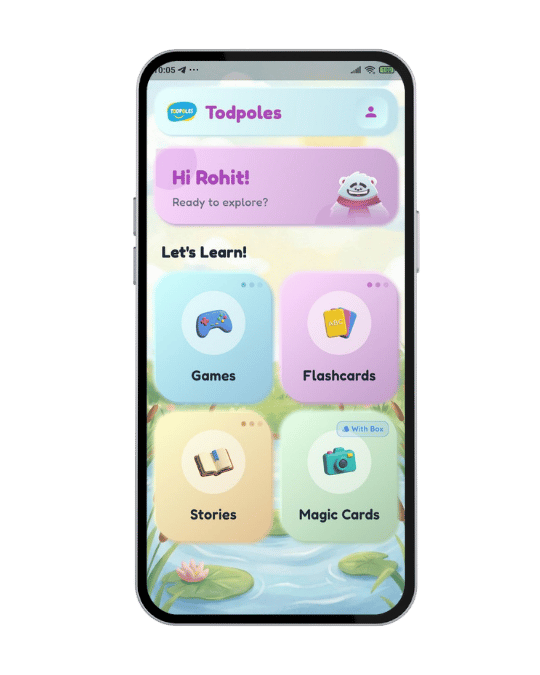
The most effective approach combines physical flash cards with brief digital reinforcement. A child holds an alphabet card, hears the sound from a parent, then scans the card with the Todpoles app to hear the correct pronunciation and play a matching game. The physical learning comes first; the app deepens it.
For children who are ready to begin connecting sounds to early reading, letter tracing worksheets add the motor memory dimension — tracing the shape of a letter while saying its sound creates an additional layer of encoding that reading-readiness research consistently supports.
Signs that phonics is working
Progress in phonics is often quiet — it happens inside a child’s head before it shows up in behaviour. But there are clear signals that the connections are forming:
- They start pointing out letters on signs and in books and saying their sounds spontaneously
- They attempt to “sound out” unfamiliar words by going letter by letter
- They notice when a word in a book starts with the same sound as their name or a word they know
- They begin to write letters when they want to communicate something — even if the spelling is approximate
- They ask “what does that say?” about text they encounter in the world
Any of these signals means phonics is landing. Keep going at the same gentle pace — consistent, short, playful sessions will get a child from sound awareness to early decoding faster than any intensive programme.
Frequently asked questions
At what age should I start teaching phonics?
Phonemic awareness — the oral, sound-focused groundwork — can start from age 2 through rhyme games and sound play. Formal letter-sound connections (phonics proper) are best introduced once a child can recognise several letters by sight and enjoy sound games, which for most children is between 3½ and 5. Starting too early with formal phonics, before phonemic awareness is in place, tends to produce confusion rather than progress.
Should I teach synthetic phonics or analytic phonics?
Synthetic phonics — teaching individual letter sounds and blending them together — is the approach most strongly supported by research for early readers. Analytic phonics works from whole words down to sounds. For home use with toddlers and pre-schoolers, the distinction matters less than consistency: pick one approach and stick with it. The activities in this guide are primarily synthetic in approach — individual sounds first, blending later.
My child knows all their letters but can’t blend — what should I do?
Letter recognition and blending are different skills, and it’s common for one to be ahead of the other. If your child knows letters but can’t blend, focus on oral blending games first — the stretchy word game above is ideal. Start with two-sound words: “What word is /m/-/e/?” Then move to three sounds. Physical and visual letter cues can come back once the oral skill is more fluent.
How do I teach phonics without confusing my child with exceptions?
Start with fully phonetically regular words and sounds — sat, pin, mop, bed, cut — and ignore exceptions entirely at first. English has many irregular words, but the core phonics code covers the vast majority of simple text. Once a child has solid foundations with regular sounds, exceptions can be introduced one at a time as sight words. Don’t let perfect be the enemy of good: phonics rules work often enough to be enormously useful, even if they don’t work every time.
Start with Todpoles Alphabet Flash Cards
26 illustrated cards — each showing the uppercase and lowercase letter, a picture word, and the correct sound. Pair them with the free Todpoles app to hear every letter sound and practise matching. Designed for children aged 2–7.
Todpoles App
More learning with Todpoles
The Todpoles app turns these letters into interactive games. Scan any flash card, hear the letter sound, and play matching activities — all anchored to the physical learning your child is already doing with these worksheets.