
Do Flash Cards Actually Work? What the Research Says

You’ve seen the claims. Flash cards make children smarter. Flash cards are harmful. Flash cards are just rote learning. Flash cards are the secret to early literacy. Which is it?
The honest answer sits somewhere in the middle — and it depends almost entirely on how you use them. Here is what the research actually says, what parents get wrong, and what works.
What the research says
Several decades of cognitive science research support one core idea: spaced repetition works. When children see, hear, or touch the same piece of information repeatedly — with small gaps in between — they retain it significantly better than when they cram it in one session.
Flash cards are a physical tool for spaced repetition. The Todpoles flash card sets cover alphabets, numbers, colours, shapes, and Hindi. A 2013 study published in Psychological Science found that retrieval practice (being prompted to recall something, rather than just re-reading it) produced stronger long-term memory than passive review. Flash cards, used as retrieval prompts, tap directly into this effect.
A 2019 study from the University of Virginia found that toddlers aged 15–24 months could learn new words from flash cards when a caregiver named the picture and engaged with the child during the session. The key phrase: when a caregiver engaged. Cards left alone on a table did nothing. Cards used in conversation produced real vocabulary gains.
The problem with how most people use flash cards
The failure mode is drilling. Parent holds up a card. Child says the word or doesn’t. Parent moves to the next card. Twenty cards in five minutes. Session over.
This produces short-term recognition and almost no retention. It also makes the child associate learning with something slightly anxious and performance-based, which is the opposite of what early learning should feel like.
Three things that make flash cards not work:
- Too many cards per session. A child aged 2–4 can meaningfully engage with three to five items in a single sitting. Twenty cards produces overwhelm, not learning.
- No multi-sensory connection. Seeing a picture of an apple is weaker than seeing a picture of an apple while saying the word aloud while remembering the smell and taste. The more senses involved, the stronger the memory trace.
- No follow-through. A flash card session that ends with the cards going back in the box and nothing reinforcing the learning for the next three days is largely wasted.
What makes flash cards genuinely effective
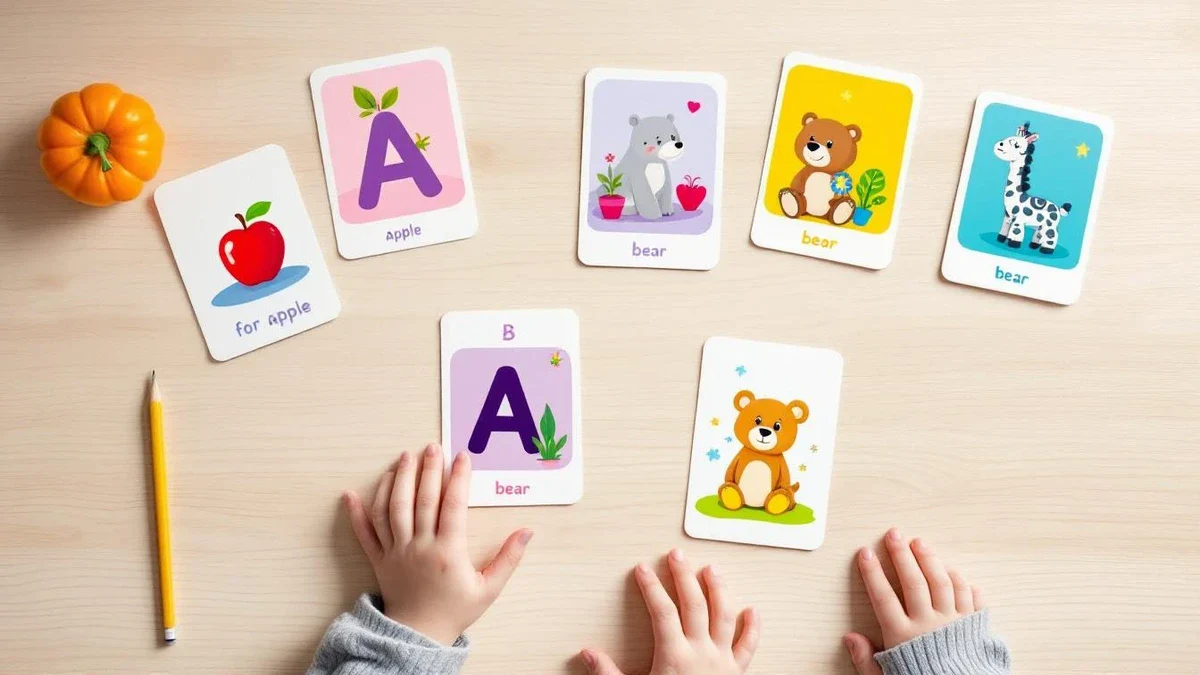
Research and experience both point to the same conditions:
- Short sessions, high frequency. Five minutes every day beats thirty minutes once a week. Young children’s attention windows are short; working within them rather than against them is the difference between engaged and switched off.
- Parent presence and narration. The caregiver names the card, makes a comment, asks a question. “That’s the letter A. A says /æ/ — like in apple. Can you say apple?” The conversation is the learning, not the card itself.
- Connecting to something the child already knows. A flash card for the letter T lands better when a child already loves tigers. Starting with what is familiar and extending outward is how young children build knowledge.
- Mixing review with new material. Revisiting cards from last week alongside new ones this week is how spaced repetition creates durable memory. If every session introduces 10 new cards and never revisits old ones, retention will be poor.
- Making it feel like play. Games, songs, movement. “Can you put the letter A card on the bear’s head?” is more effective than “What does this say?”
Physical cards outperform screens — but physical + digital is best
A 2020 meta-analysis comparing physical vs. digital learning materials for children under 6 found that physical materials produced stronger learning outcomes across almost every category. Researchers attributed this to the tactile engagement of handling physical objects and the absence of distractions that come with screens.
However, the same research found that combining physical materials with brief, structured digital reinforcement — hearing a letter sound, seeing an animation — produced the strongest results of all. The physical card builds the initial association; the audio and visual reinforcement deepens it.
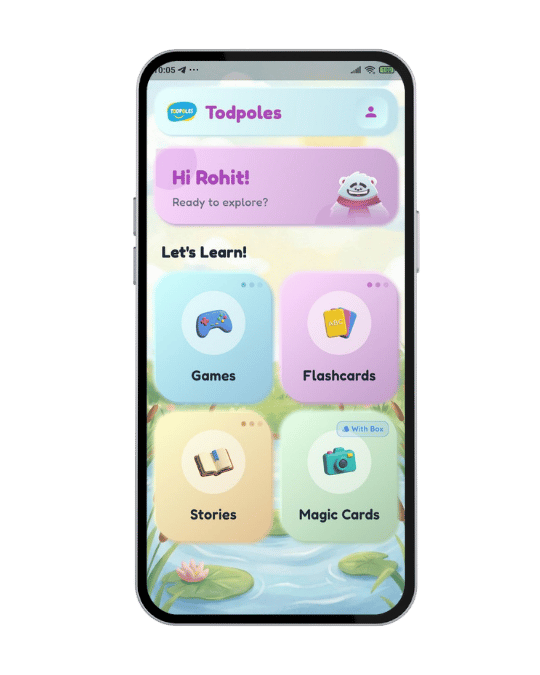
This is the thinking behind how Todpoles works. A child holds a physical flash card, traces the letter shape or looks at the picture, and then scans it with the free Todpoles app to hear the correct pronunciation and play a simple matching game. The physical and the digital work together rather than replacing each other.
The bottom line
Do flash cards work? Yes — when used correctly. Short, frequent, playful sessions. Parent present and engaged. Multi-sensory where possible. Revisiting old material alongside new. No pressure, no performance, no drilling.
Used that way, flash cards are one of the most efficient early learning tools available. Used poorly — too many cards, too fast, no follow-up — they produce frustration on both sides and very little learning.
Frequently asked questions
What age should I start using flash cards?
Most children show readiness for simple picture flash cards between 12 and 18 months. At this age, the focus should be on naming and recognising pictures, not letters or numbers. Letter and number flash cards work well from around age 2½ to 3, when children begin to notice and imitate written symbols.
How many flash cards should I show per session?
For children aged 2–3, three to five cards per session is plenty. For children aged 4–6, you can work with up to eight to ten. Revisit the same cards across multiple sessions before introducing new ones. Retention, not novelty, is the goal.
Do flash cards help with reading?
Alphabet flash cards build letter recognition and phonemic awareness — two of the foundational skills for reading. They do not teach reading on their own, but children who enter school with strong letter recognition and sound knowledge consistently learn to read faster and with less difficulty.
Todpoles App
More learning with Todpoles
Everything you read about in this guide comes to life in the Todpoles app. Interactive letter games, real flash card scanning, and guided play activities — designed for children aged 2–7, with no ads, no pressure, and no screen guilt.